A large part of our role as a SIMNA Organising Committee is facilitating a community of practice around Social Impact Measurement. We’re also very mindful that the feeling of this community is safety, support and acceptance, where “trying and learning” is celebrated over perfection and expertise.
 To keep progressing this, and because we wanted to live the “try and learn” spirit of SIMNA, we planned a different kind of event for our mid-year get-together. The event was hosted and supported (read: great food and hospitality!) by EY in Sydney on Wednesday 3rd July, and it was branded as an after-work, networking-ish kind of event.
In approaching the event, with our objectives in mind, we had some framing challenges we wanted to work through:
- Traditional “networking” events don’t suit everyone – particularly introverts. They’re fine if you already know people to cluster with, but they can be full of small talk and awkward forced conversations when you’re new to a community.
- Social Impact Measurement is full of individual, often unique, challenges. It is rare that two practitioners will have the same problem, and so running “hands-on” events around a particular topic is a challenge.
In addressing the above we designed a process to support small group, focused conversations about individual SIM challenges through a learning-circle style event. In this way, it was hoped that a table could achieve some of the following concurrently:
- Have a pressing, real-world problem solved
- Meet other practitioners, and feel a part of the SIMNA community
- Jump the small-talk, by talking about something that we’re all passionate about and that brings us together
- Learn from the perspectives and experiences of others
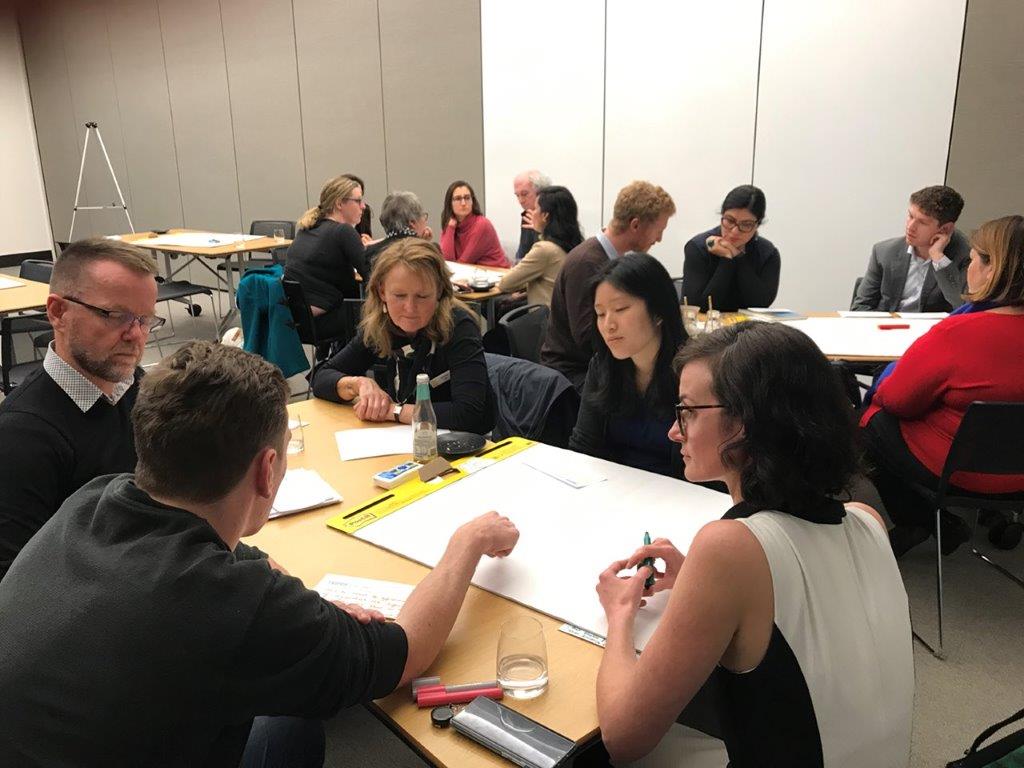
 To give the event some structure, we put together a facilitated process (below) to give tables a framework or way to approach the conversations. In essence, every participant had to introduce themselves and present a problem or challenge they were having, and the table as a whole decided with problem to tackle together. They then moved through the process of offering perspectives and potential solutions, with the challenge owner being able to take these thoughts back to their workplace.
In order to maximise networking, after one “challenge” at each table, participants had to re-form groups, mixing with new people to take on a second challenge.
 Objectively the event was a success. The room was full, which indicates to me that our growing community understood and liked the concept and its communication. The post event feedback (N=9) was also mostly positive, with 66% of attendees rating the information shared as either “extremely useful” or “very useful”, and 55% rating the networking as either “extremely” or “very beneficial”.
As the facilitator, the event also looked like a success. The conversations took off quickly (safety = high), and headed in unique directions which seemed to be a response to the unique challenges of each table. I often couldn’t get people to stop talking (which is always my favourite problem in a room of people who didn’t know each other 10 minutes ago!), and the conversations I heard were often digging deeply into the practical challenges of SIM.
 Two of our SIMNA committee were at tables, and the topics they reported on reflected the hoped-for plurality of topics covered. Cathie’s table looked at the challenge of engaging commercially-oriented boards with social sector business models, and understanding the balance of “mission and margin” in leading an organisation.
Being SIMNA, we’re all about the learning! In combining all of the above, I’d say that our learning for future events is:
- This type of event is a useful format to enable networking, and to cover a range of flexible, user-centred topics;
- The format and location may suit some types of SIM practitioners over others. We seemed a little consultant-heavy, and potentially lighter on front-line workers than our usual panel/expert events;
- The event still felt a little formal for an “after work” affair. In future, we would probably include some extra aspects (e.g. drinks, different activities) to make it feel more casual.
Dean Williamson, SIMNA Sydney Committee