SIMNA QLD’s first 2018 Event Social Benefit Bonds – Lessons from the Front Line was held on Monday 26th March 7.30 – 9.00 am, at Deloitte, and an enthusiastic 50-strong audience joined us a to learn first-hand about the challenges and opportunities of the recently launched Social Benefit Bonds(SBB’s) from the commissioners, the investors, and the service providers themselves.
The Queensland Government has supported the launch of three new programs:
- YouthConnect – an initiative that seeks to complement existing programs through individualised case management and interventions to help build protective factors in young people up to 25 years exiting out-of-home-care (OOHC).
- NewPin – a program aiming to increase the reunification of Aboriginal and Torres Strait Islander children currently in out-of-home care.
- Life Without Barriers – a program committed to reducing reoffending rates, particularly among young offenders.
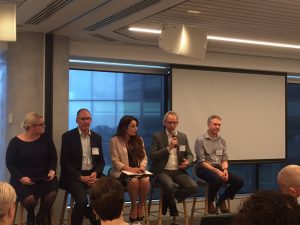
An excellent well-informed panel comprising: 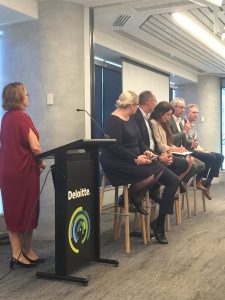
- Kathleen Begley, Program Manager, Social Benefit Bonds Pilot Program
- Robyn Robertson, Manager, New Business Team, Field Impact Group World Vision
- Brad Swan, Executive Director, Strategy and Engagement, Life Without Barriers
- Patrick Farrell, Head of Investments, Suncorp Group
- Dr Stuart Middleton, Lecturer International Business and Management University of the Sunshine Coast
The panel shared their views and responded to audience contributions on a range of questions:
- What was it like for those involved in putting together the Queensland bonds?
- What have been the challenges and success factors of this phase?
- What would they do differently, if approaching this again?
- What is happening globally in the impact investing space?
- How can Queensland take these lessons to apply to any future investments?
Some extracts from the presentations and discussions.
Kathleen Begley (Social Benefit Bonds Pilot Program) set the scene with an overview of the Government’s aims and approach. SBB’s were a first in that there were three transactions enabled through one procurement process. Each transaction involved four players – government, the service provider, the financial intermediary; and the investors. The key challenge was finding trusted, reliable and measurable propositions, and translating them into a financial model. On lessons learned, she cited the importance of building a data system that would need to be less dense and more streamlined than the one initially created; and ‘cracking the walnut’ of building a simpler common financial model which could accommodate the diversity of projects approved.
Robyn Robertson (World Vision) talked of the role the SDG’s have played in formulating a global strategy and the changing global context, for example DFAT-led outcomes-based funding creating a more complex system which NFP’s are struggling with. Development Impact Bonds can have seven or more ‘actors’ while the sector is used to dealing with a ’single voice of intent’ and has little experience of negotiating. A big challenge is in the design stage, getting everyone around the table, and then to work at a pace which is comfortable for everyone. Robyn emphasised the importance of understanding your value proposition as an organisation, particularly in multilateral contributions to outcome payments.
 Brad Swan (Life Without Barriers) made the point that LWB were already supporting bonds through an investment in the NSW Benevolent Society initiative. Reflecting on their experience to date, he made a number of observations; the exercise had been expensive, with LWB needing to make a very sizeable commitment of their own , most of which they would be unlikely to recover; they would have benefited from more preparation and skill-building to establish a stronger negotiating position, and being clearer on what was negotiable; also to have a stronger focus on what was attractive to investors, and adjust their strategy accordingly.
Patrick Farrell (Suncorp) emphasised that while there is a desire to invest in improving the social fabric, we need to take decision makers such as superannuation fund trustees down the road of understanding the different aspects of risk and return in these situations. His key points centred on the need for investors to satisfy themselves about the proponents’ capability to deliver; ‘following the cash’ – to establish robust processes to define the value in our portfolio; and to deal with the issue of scale – these deals are relatively small investments but need the same amount of process and due diligence as multi-million dollar investments.
Being directly involved in one of the bidding teams and undertaking research into the broader area of impact bonds gave Dr Stuart Middleton (University of the Sunshine Coast) two different perspectives. Walking into the Eagle St State Government offices to meet with teams of advisers was quite confronting, and he agreed with others that new skill sets were needed to be effective in this space. His research had drawn out a number of points: often there were clashes between the need to innovate while staying within the status quo; on the whole he felt that ‘Governments were too risk-averse’ and NFP’s often ‘not professional enough’; there needed to be more time for relationship-building prior to the specific negotiation phase; and missing from the negotiations was ‘the client’ for whom the NFP is uniquely placed to advocate.
Contributions from the floor included several comments about the crucial importance of defining the data to be collected, and capturing and analysing it across the lifetime of the program; the need to be innovative in defining the outcomes to be measured; understanding the sizeable commitment needed by NFP’s to create the case for support, have in place quality propositions that are supported by solid data sets; the critical importance of the financial intermediary; and the changing nature of corporate social responsibility which is prompting more corporate interest in this area.
The session closed with extended networking over an excellent breakfast, and a clear sense of the benefit of continuing the conversation at a follow up event.
Ends
Jerry Marston, Co-Chair SIMNA QLD Organising Committee, April 2018