On Wednesday 16th March SIMNA NSW hosted a breakfast workshop about the role of technology in assisting social outcomes measurement. In an environment where social outcomes measurement often requires at least time and human resources to get started, and potentially a culture change, we asked the question, can technology make it easier?
We were lucky to have Greg Simmons from Blackbaud, talking about his experiences as distributor of US technology solution Efforts to Outcomes (ETO), along with Amanda Pagan from the Brotherhood of St Laurence (BSL) in Victoria to talk about her recent experience using the tool. The event was facilitated by SIMNA Committee member, and our technology go to guy, Andrew Callaghan from Karrikins Group.
Greg Simmons answered our question and kicked off by declaring, “I have a passionate belief that technology can improve outcomes measurement in the not-for-profit sector”. In particular, Greg believes in the potential of technology to engage front-line workers in outcomes data collection and measurement, and the significant and often untapped opportunity in using this data to improve practice. Technology has the potential to disrupt the tension that often emerges between front-line workers and traditional researcher led evaluations by providing data in shorter time frames in a highly inclusive manner.
But critically, these tech tools need to be fit for purpose. Both Andrew and Greg spoke of the challenges in engaging workers who have often had poor past experiences due to the proliferation of not fit for purpose tools being used across a range of sectors to attempt to measure outcomes. This has led to often overly burdensome, poor quality and underutilised data collection practices.
Greg’s search for a fit for purpose social outcomes measurement tool started when tasked with adapting a generic customer relationship management system into an outcomes based client management system. The search led him to Social Solutions in the US, founded by youth case workers in Baltimore, who had developed ETO as a way to track outcomes and provide a performance management system.
Reflecting on his experience in assisting not-for-profits in Australia implement ETO, Greg identified the key strengths of ETO as the:
- Ability to monitor and track service delivery activity;
- quality improvement element that encourages program / service fidelity;
- clear view of outcomes and accountability for capacity building and fundraising purposes;
- strong synergies with other outcomes measurement frameworks such as Results Based AccountabilityTM (RBA).
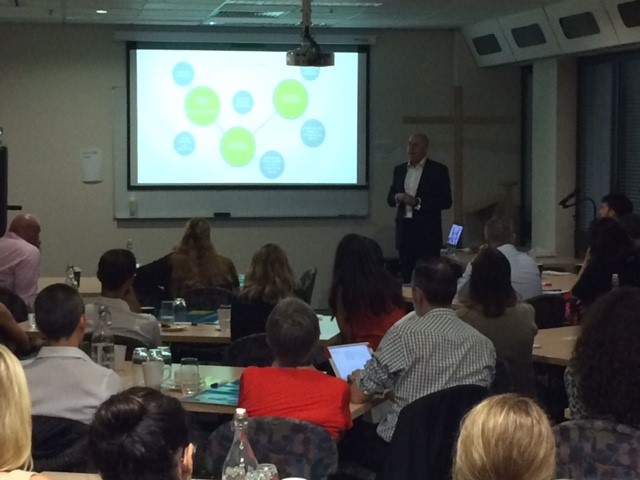
Amanda Pagan joined us via video-conference from Melbourne and generously spoke of the BSL’s experience in implementing ETO and RBA as a pilot outcomes measurement framework and system for two of their programs. BSL is a service delivery and advocacy organisation, primarily focussed on education and employment, and structured around the key life transitions: early years, through school to work, in and out of work and retirement and ageing.
From initially having limited capacity to report both activity and outcomes, Amanda talked about the process of applying ETO and RBA in two programs from mid-2015. While there were some challenges in agreeing performance measures for RBA with all staff – namely the need to emphasise the priority of this stage and maintain momentum once started – the RBA and ETO implementation process has enabled BSL to meet their outcomes and client management system needs. She could speak to the program improvements already underway as a result of this outcomes collection and reporting. “As a result of ETO and RBA, we’ve started to see the focus on reading really become a focus within our HIPPY program, and we’ve got greater visibility on the rates of job retention in our employment program that is supporting labour hire.”
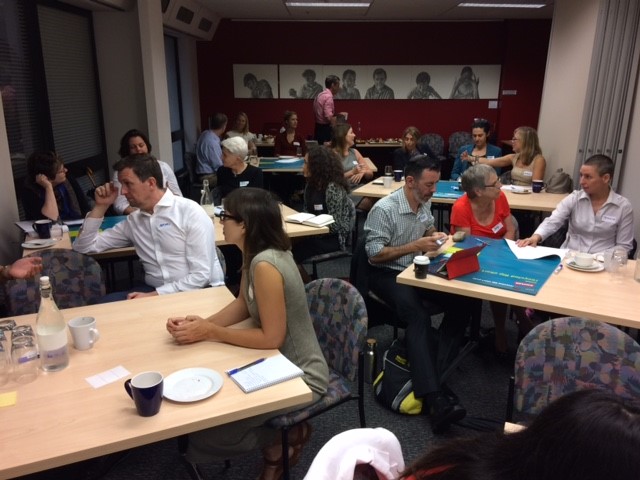
The breakfast event included much lively discussion among the group regarding the current experiences, challenges and potential of better integrating technology to track social outcomes.
SIMNA NSW is extraordinarily grateful to Uniting for hosting us and to Andrew, Greg and Amanda for being so generous with your time and willingness to share your experiences.